Google Maps Ranking for Septic Companies
Septic isn't an urban trade, so the usual Map Pack advice half-applies. Wide rural service areas change how proximity works, and hand you a far bigger map to win than a plumber ever gets.

Most “how to rank on Google Maps” advice is written for urban trades: plumbers, HVAC, electricians packed into a metro. Septic is different enough that following that advice blindly leaves easy wins on the table. The good news is the differences mostly work in your favor. A septic company can realistically own a far bigger stretch of the map than a plumber ever will.
Quick answer
Rank a septic company in the Map Pack by winning Google’s three local factors: relevance (correct Google Business Profile categories), proximity (a verified location and a real coverage area), and prominence (steady reviews and jobsite activity). But the fastest edge in septic is three basics most competitors never nail together: a Septic system service primary category, a verified physical location, and the word “Septic” in your business name. Get those three clean and the wide, sparsely-contested rural radius does the rest. You can rank across whole counties, not just a few zip codes.
We build and run marketing for septic companies, so let’s skip the generic checklist and focus on what’s actually different about septic.
Why septic ranks on a bigger map
Proximity is one of Google’s top Map Pack factors: the closer a business’s verified location is to the searcher, the higher it tends to rank. In a dense city, that’s brutal. Dozens of competitors sit within a few miles, so your “winnable radius” is tiny and every zip code is a knife fight.
Septic is the opposite.
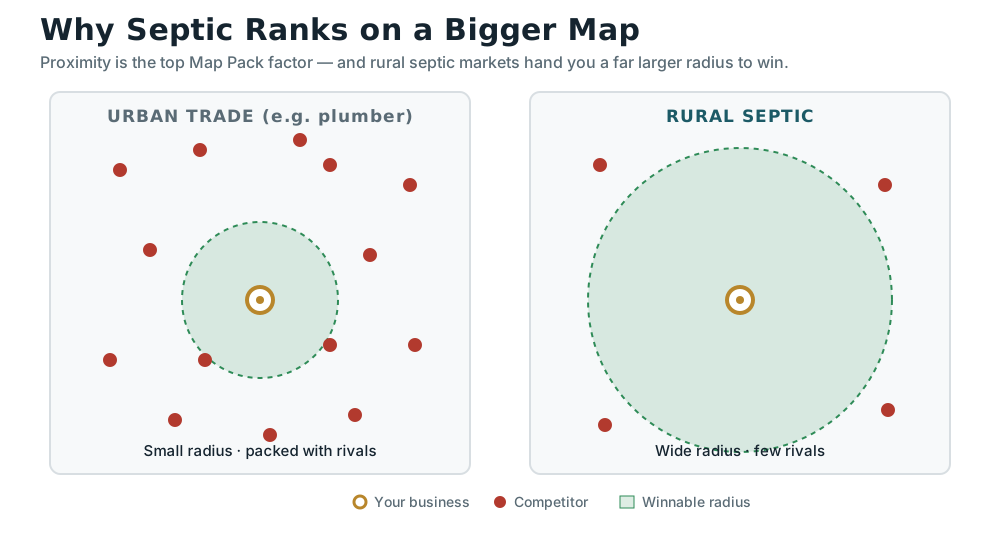
Because septic markets are rural or exurban, competitors are spread thin and the distances are large. That means the radius in which you can realistically win the Map Pack is much wider than a plumber’s. Where a city plumber fights for a two-mile bubble, a septic company can hold the pack across whole counties. The lever most septic operators miss is that they under-claim this. They set a tiny service area and never build activity out to the edges of the territory they could actually own.
The three levers most septic companies never nail together
Here’s the part the generic guides miss. In practice, the biggest Map Pack wins in septic come down to three basics done cleanly, and the real edge is that almost no competitor gets all three right at the same time. Most nail one, maybe two.
-
Primary category set to Septic system service. This is the strongest relevance signal on the whole profile. Set your primary category to your core septic service (not “excavating contractor,” not a generic “contractor”) and add real secondaries below it. The full stack is next.
-
A real, verified physical location. A genuine business address Google can verify is a proximity anchor: it’s part of how Google decides how close you are to each searcher, and it lends legitimacy that a bare, address-less profile doesn’t have. If you run from a real shop or yard, verify it and use it. This is exactly where a lot of septic companies get sloppy or skip the step, and it quietly costs them rank.
-
The word “Septic” in your business name. A business name that legitimately contains your service keyword (like True Septic) is one of the most powerful and durable relevance signals in local search. If you’re naming or rebranding, put “Septic” in the name. If it’s already there, you’re holding an edge most of your competitors don’t.
Do all three cleanly and you’re ahead of most of your market before you’ve earned a single review. It isn’t exotic; it’s just rarely executed completely.
What about hiding your address? If you have a real business location, use it: a verified address is an asset, not a liability. The only reason to hide it is if you genuinely work out of your home with no business premises, which is the narrow case Google’s address-less setting is meant for. Either way, still set your coverage to the actual counties and towns your trucks serve, not an aspirational radius.
Your full category stack
Lever 1, in detail. Your primary category carries more weight than any other field on the profile, so set it to your core septic service. Then add secondary categories for the other services you genuinely perform.
| Role | Category | Use it when |
|---|---|---|
| Primary | Septic system service | Your core business, almost always the right primary |
| Secondary | Sewage disposal service | You pump and haul waste |
| Secondary | Portable toilet supplier | You rent portable toilets / holding tanks |
| Secondary | Excavating contractor | You install systems and dig drainfields |
| Secondary | Septic tank cleaning service | If listed separately in your market |
Only add what you actually do; false categories confuse Google and erode trust. Pick the primary deliberately; it’s the strongest signal on the whole profile.
One to confirm for your market: category availability and what performs best varies by region and shifts as Google updates its category list. Treat the stack above as a strong starting point and validate the exact primary against what’s already ranking in your territory.
Flank the downtown competitor by hugging the outskirts
Here’s a subtle move most operators get backwards. Septic systems exist where there’s no municipal sewer: the rural edges, unincorporated pockets, and outskirts of town. So your actual customers almost never search from downtown; they search from their homes, out on the periphery.
The Map Pack ranks on proximity to the searcher. That means the biggest company in town, sitting on a prestigious downtown address, is optimized for proximity to downtown, where hardly any septic customers live. He thinks the central address is an advantage. For septic, it’s often a blind spot.
So flank him. He usually holds the downtown address, and you don’t need to match it, or run out to the middle of nowhere. Position your real location slightly outside downtown, hugging the outskirts on the side where the septic homes actually are. That puts your proximity closer to the outlying customers than his, and it walls him off: you intercept the proximity signal for the residential ring that needs you, while his reach stays pinned to the center of town he optimized for.
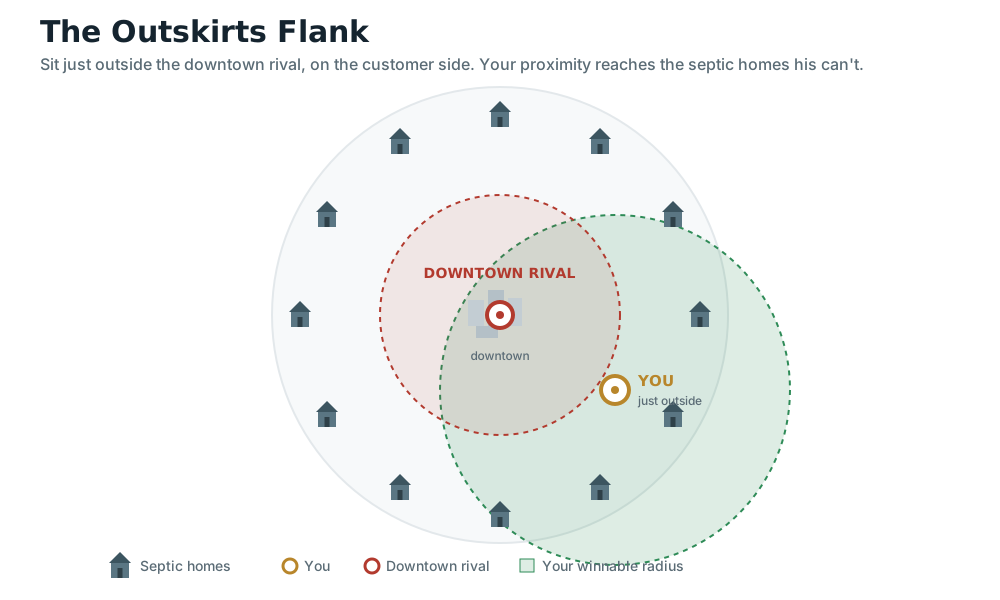
The rule: don’t plop in the middle of nowhere, and don’t fight for a prestige central address either. Sit just outside the downtown competitor, on the customer side, where the real septic homes are.
Win reviews on septic math, not plumbing math
Septic does fewer, larger jobs than a high-volume plumber, so you’ll never out-volume an urban trade on reviews, and you don’t need to. In a rural pack where competitors sit on eight reviews from two years ago, consistency beats volume. A septic company that quietly asks for a review after every pump-out and install will build steady, recent velocity that Google reads as ongoing activity, and pull ahead of rivals with a bigger but stale count.
The rule: recency and steady velocity over a one-time push. Five fresh reviews this quarter outrank fifty from three years ago.
Feed the profile real activity
Rankings follow proof of activity. The septic companies that hold the pack across a wide territory are the ones constantly signaling “we work here.” Real, geo-tagged job photos pushed from actual job sites (the kind our jobsite pins system publishes automatically) tell Google you genuinely operate in the towns at the edges of your service area, which is exactly how you expand the zone where you rank. Generic stock photos do none of this.
Track it with a grid, not a single search
Don’t judge your ranking by searching your own name from your own kitchen. Because proximity shifts the pack for every location, you need a grid. A tool like Local Falcon checks your rank from dozens of points across your service area and shows you a heat map of where you lead and where you fade. For septic, that grid is unusually satisfying: the wide winnable radius means you can watch your green zone expand town by town as activity and reviews build.
Common mistakes
- A weak or wrong primary category. The highest-leverage field on the profile, often set to “contractor” or “excavating” instead of Septic system service.
- No verified physical location. A real address is a proximity anchor most septic companies leave on the table by running address-less or never verifying.
- A generic business name. If “Septic” isn’t in your name, you’re giving up a durable relevance signal your competitors could be handing you.
- Using plumbing-sized service areas. Under-claiming your territory caps how much map you can win.
- Chasing review volume instead of velocity. A stale pile loses to a steady trickle.
- Judging rank from one search. Without a grid you’re blind to the towns where you’re already winning, or losing.
Proof
We built exactly this for True Septic in Oklahoma: a verified location, the right primary category, real jobsite proof, and steady reviews, and took a brand-new profile to #1 in both the Tahlequah and Muskogee map packs while expanding its winnable radius across the surrounding territory.
The bottom line
Septic isn’t an urban trade, so stop marketing it like one. Get a real verified location near your customers, set the right primary category, put “Septic” in your name, win reviews on recency, and feed the profile real jobsite activity, then watch the wide rural radius work for you. The map you can own is bigger than you think.
Want the whole thing built and run for you (profile, reviews, jobsite proof, and grid tracking wired together)? That’s what we do for septic companies.
Frequently asked questions
What actually moves a septic company's Google Map Pack ranking?
Three things, in order: relevance (your Google Business Profile categories and services match what people search), proximity (how close your verified location is to the searcher), and prominence (reviews, activity, and citations that signal authority). For septic, proximity behaves differently than for urban trades because service areas are wide and competitors are sparse, which usually works in your favor.
Why does my septic company rank in some towns but not others?
Proximity. The Map Pack is recalculated for each searcher based on where they are, so you naturally rank strongest near your verified address and fade as searchers get farther away. In rural septic markets the drop-off is gentler because there are fewer competitors to displace you, but you'll still see your ranking change town to town. Defining your service area correctly and building activity across it widens the zone where you hold.
What Google Business Profile categories should a septic company use?
Set your primary category to the one that matches your core money service, most often 'Septic system service.' Then add secondary categories for the other real services you offer, such as sewage disposal service, portable toilet supplier, or excavating contractor. Only add categories you genuinely perform; the primary category carries the most ranking weight, so choose it deliberately.
How many reviews does a septic company need to rank on Google Maps?
There's no magic number; it's relative to your market. In rural septic areas where competitors have a handful of reviews, forty to fifty steady, recent ones can be enough to lead the pack. What matters more than the total is velocity and recency: a consistent trickle of new reviews after each job signals ongoing activity far better than a big one-time batch.
Does a septic company need a physical location to rank on Google Maps?
A real, verifiable business location is one of the biggest advantages you can have. It acts as a proximity anchor and adds legitimacy that a bare, address-less profile lacks. If you operate from a genuine shop or yard, verify it and use it. Google's guidelines only call for hiding an address when you're a pure service-area business with no premises customers visit, so run fully address-less only if you truly work from a home with no business location. Either way, still define your real service area.
Where should a septic company locate to rank best on Google Maps?
Flank the downtown competitor. Most rivals sit on a central address, but septic customers search from the outlying homes where the systems are. Position your verified location just outside downtown, hugging the outskirts on the customer side, so your proximity to those searchers beats the central incumbent's. You're not heading to the middle of nowhere; you're sitting between downtown and the residential ring you want to own.
Ready to own the territory?
Send the market, the trucks, and the goal. We’ll map the stack and show you where the leverage is.