How to Get More Septic Customers
Septic isn't one business. It's three, and each one is won a different way. Here's the demand triangle most septic companies never separate, plus the recurring-customer lever almost nobody works.
If you run a septic company, “get more customers” is the wrong goal, because septic isn’t one business. It’s three businesses wearing the same truck, and each one is won a completely different way. Most operators market all three as if they were one, which is exactly why their calendar swings between slammed and silent.
Quick answer
Separate your demand into three buckets: Emergency (backups and alarms), Capital (new systems and drainfields), and Routine (pump-outs and inspections). Market each on its own logic. Emergency work is won on speed (Map Pack + Local Services Ads). Capital work is won on trust (reviews, licensing, proof). Routine work is won on memory: reminders to the customers you’ve already served. That last one is the biggest, cheapest lever in the trade, and almost nobody works it.
We build and run marketing for septic companies, so this isn’t theory pulled from a generic “get more customers” checklist. Start with the model, then the moves.
The septic demand triangle
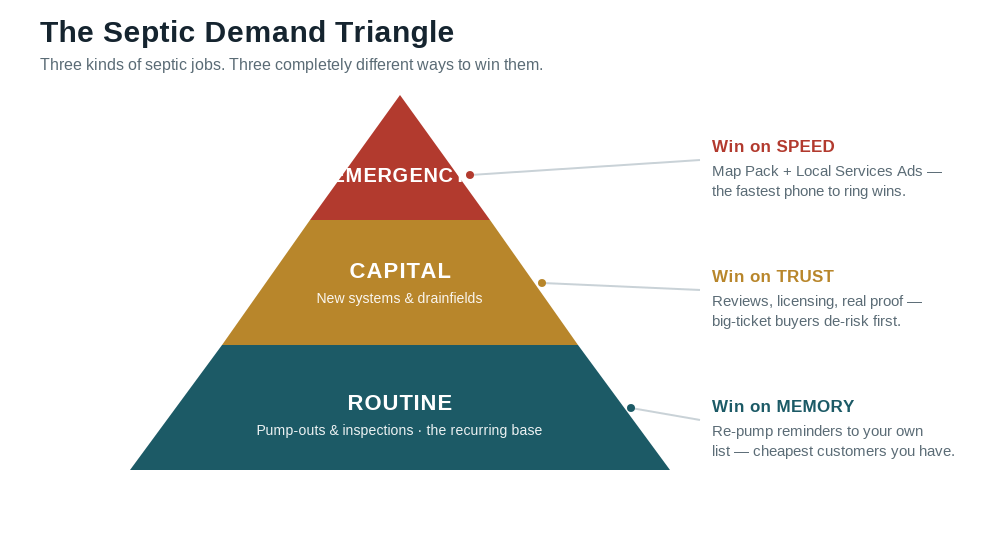
Emergency (the tip). A tank backs up, an alarm goes off, sewage is where it shouldn’t be. These callers don’t comparison-shop. They call whoever appears first and answers. You win here purely on visibility and response time: ranking in the Google Business Profile Map Pack for your service area and running Local Services Ads so you sit above the organic results with a “Google Guaranteed” badge. High urgency, high willingness to pay, but relatively few jobs. Build your whole business on emergencies and your revenue rides a roller coaster.
Capital (the middle). New system installs, drainfield replacements, tank swaps: the four- and five-figure jobs. Nobody panic-buys a $12,000 drainfield. They research, they get quotes (this is where ranking organically with septic SEO puts you in the running), and above all they de-risk. This is a trust sale, and septic buyers de-risk on one thing harder than price: is this company licensed, permitted, and going to pass county inspection? Your marketing for capital work is proof: reviews, real project photos, plainly stated licensing and permitting, and case studies of jobs like theirs.
Routine (the base). Pump-outs and inspections. Lower ticket, but it’s the wide base of the triangle because it’s recurring and predictable — and it’s where the money you’re leaving on the table lives.
Work the re-pump flywheel (the lever nobody pulls)
Here’s the septic-specific fact that changes everything: a residential tank needs pumping roughly every 3 to 5 years. That means every pump-out you have ever completed is a customer who is guaranteed to need you again on a knowable schedule.
Almost no septic company does anything with that. They pump the tank, cash the check, and forget the customer, then spend money on ads to acquire a stranger while a warm, pre-sold customer sits in their invoice history, due for service, hearing nothing.
The fix is boring and enormously profitable:
- Tag every job with a re-service date at the time you pump it (three years out for a standard household, sooner for heavy use or commercial).
- When that date comes up, reach out with a postcard, a text, or an email. “Your tank is due. Want us back on the schedule?”
- Track it like the recurring revenue it is.
This turns one-time jobs into a subscription you never have to sell twice. It fills your slow season. And it costs a fraction of buying a new lead. If you do one thing after reading this, mine your own customer list.
Open the referral channel most septic companies ignore
There’s a second demand source hiding in plain sight: real-estate transactions. Most home sales with a septic system trigger a required septic inspection, and often a pump-out or repair before closing. The people who control that timing (real-estate agents, home inspectors, title companies) refer the septic company they trust, over and over.
Become that company. A handful of reliable relationships with local agents can produce a steady drip of inspection-and-service jobs that never show up as a Google search at all. It’s low-effort, high-loyalty demand that your competitors are walking right past.
Build a soil profile page (the highest-value page most septic companies skip)
Here’s a play almost nobody in the trade runs, and it feeds the biggest job on the menu. Before anyone installs a new septic system, the property needs a soil profile test: a soil evaluation (often called a perc or percolation test) that determines what kind of system the land can support. Homeowners and builders search for it by name: “soil profile test,” “perc test near me,” “septic soil evaluation.”
Here’s why it’s gold: someone searching for a soil profile test is someone about to install a septic system. That test almost always leads straight into an install, the highest-ticket work a septic company does and the top of the Capital tier above. Yet you wouldn’t believe how many septic companies have no page for it at all.
So build one. A dedicated page that ranks for soil-profile and perc-test searches intercepts the install customer at the very start of their journey, before a competitor does. It’s arguably the single highest-value page a septic company can put on its site: low competition, high intent, and a direct line to your biggest job.
Make trust the thing you’re actually selling
Across all three demand types, septic buyers are unusually risk-averse: it’s their property, their yard, and a permitted system they’re afraid of getting wrong. So the companies that win lead with proof, not adjectives:
- State your licensing and permitting plainly. “Licensed and county-permitted” does more work than “trusted local experts.”
- Show real jobs, not stock photos. Geo-tagged photos from actual job sites (the kind our jobsite pins system publishes automatically) prove you work in the neighborhoods you claim to serve.
- Run steady review generation. In rural septic markets, review volume is low across the board, so consistency wins. A company quietly collecting reviews after every job will pull ahead of competitors sitting on eight from three years ago.
Common mistakes that keep septic companies stuck
- Marketing all three demand types as one. Generic “septic pumping” ads that ignore capital and commercial work leave your highest-margin jobs on the table.
- Letting the customer list go cold. No re-pump reminders means paying to reacquire people you already served.
- Competing on price instead of trust. In a de-risking purchase, the cheapest quote often loses; it reads as “cutting corners on my septic system.”
- Ignoring the referral channel. No relationships with agents or inspectors means you’re 100% dependent on ads and rankings.
- No soil profile or perc-test page. It’s the highest-intent path to an install job, and most companies have nothing on their site to catch it.
- Treating reviews as a one-time task. A single review push fades; steady velocity compounds.
Proof this works
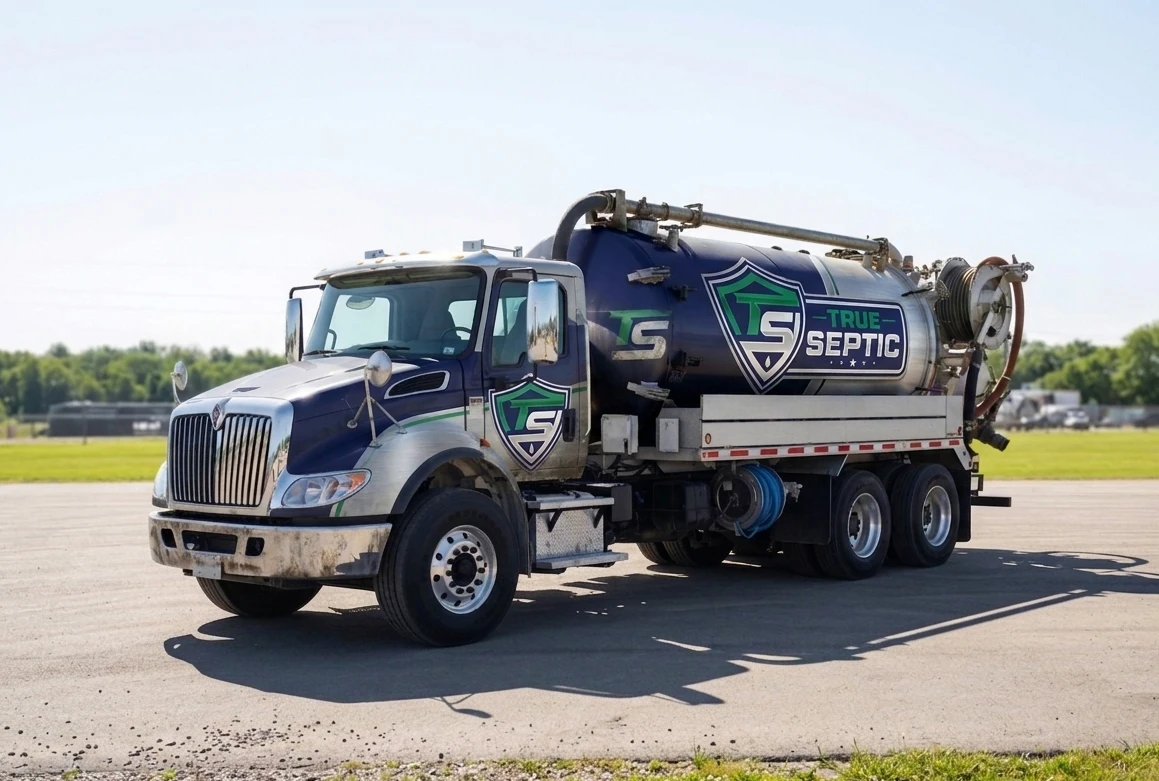
We put exactly this thinking to work for True Septic in Oklahoma. Starting from a brand-new brand, we built Map Pack visibility for emergency and routine demand, layered in real jobsite proof and reviews for the bigger jobs, and the result was #1 in both the Tahlequah and Muskogee map packs, and roughly six figures in new work inside the first 45 days. Same triangle, deliberately worked one tier at a time.
The bottom line
Stop asking “how do I get more customers” and start asking “which of my three demand types am I underworking.” For most septic companies the answer is the base of the triangle: the recurring pump-out customers already sitting in their records, never reminded. Separate the three, win each on its own logic, and the calendar stops swinging.
If you’d rather have all three run for you as one system (Map Pack, ads, reviews, and reminders wired together), that’s exactly what our septic marketing agency builds.
Frequently asked questions
What's the fastest way to get more septic customers?
The fastest lever is emergency work: homeowners with a backup or a screaming alarm call whoever shows up first in Google's Map Pack and Local Services Ads. Win the top three map results in your service area and turn on LSAs, and you capture the calls that book same-day. It's the quickest phone-ringing channel, but it's only one of three demand types, so don't build your whole business on it.
How do septic companies get repeat customers?
By treating their own past-job list as the asset it is. Residential tanks need pumping every 3 to 5 years, so every pump-out you've ever done is a customer who is due again on a predictable clock. Tag each job with a re-service date and send a reminder when it comes up. Most septic companies never do this, which is why it's the cheapest and most-ignored source of new work in the trade.
How can a septic company get more customers in the slow season?
Shift the message from emergency to routine and capital work. Slow months are when you market inspections, maintenance plans, and big-ticket repairs or new drainfields, the jobs buyers schedule rather than panic-call. Reminders to your existing customer list and content that builds trust (licensing, permits, real project proof) fill the calendar when the emergency calls dry up.
Do online reviews really bring in more septic customers?
Yes, and they matter more in septic than in high-volume trades. Septic is a lower-frequency, higher-trust purchase, so buyers lean hard on reviews before letting anyone dig up their yard. In rural markets where competitors have a handful of reviews, a company with forty consistent ones can own the Map Pack. Steady review velocity beats a one-time push.
How do septic companies land commercial accounts?
Commercial work (restaurants, mobile-home parks, campgrounds, municipal lift stations, grease traps) is won through relationships and reliability, not a single search term. Get on approved-vendor lists, show up on time, and prove you can handle recurring contracted service. It's steadier and higher-margin than residential, but it's a referral-and-relationship game layered on top of a credible online presence.
What's the highest-value page a septic company can have on its website?
A soil profile page. Before a new septic system goes in, the property needs a soil profile test (a soil evaluation, sometimes called a perc or percolation test), and homeowners and builders search for it by name. Because that test almost always leads to a full install, the biggest job a septic company does, a page that ranks for soil-profile and perc-test searches catches your highest-value customer at the very start. Most septic companies don't have one, which makes it a wide-open opportunity.
Ready to own the territory?
Send the market, the trucks, and the goal. We’ll map the stack and show you where the leverage is.