Is Plumbing SEO Worth It? (2026)
For most established plumbing shops, yes. SEO builds cheap, durable calls that keep coming for years. But it's the long game, not the fix for an empty schedule this week.

Quick answer
For most established plumbing shops, yes. SEO turns Google Search and the Map Pack into calls you don’t pay per-click for, and that traffic keeps working instead of stopping the moment you cut the budget. But it’s the long game, not an emergency fix. If your schedule is empty this week, paid ads should come first. SEO is what you build underneath so that a year from now the phone rings without you feeding a meter. It’s worth it when you can be patient and there’s real search demand in your market. It’s not the first move when you need booked jobs by Friday.
The real answer is “sometimes.” It comes down to a few things about your shop, mainly demand, patience, and the size of your average job. Below is when plumbing SEO is worth the money, when it isn’t, and the payback math to run before you spend a dollar.
Why SEO is worth it for most plumbers
The case for SEO for contractors comes down to one thing paid channels don’t have. Rankings you earn keep working after you stop paying for them.
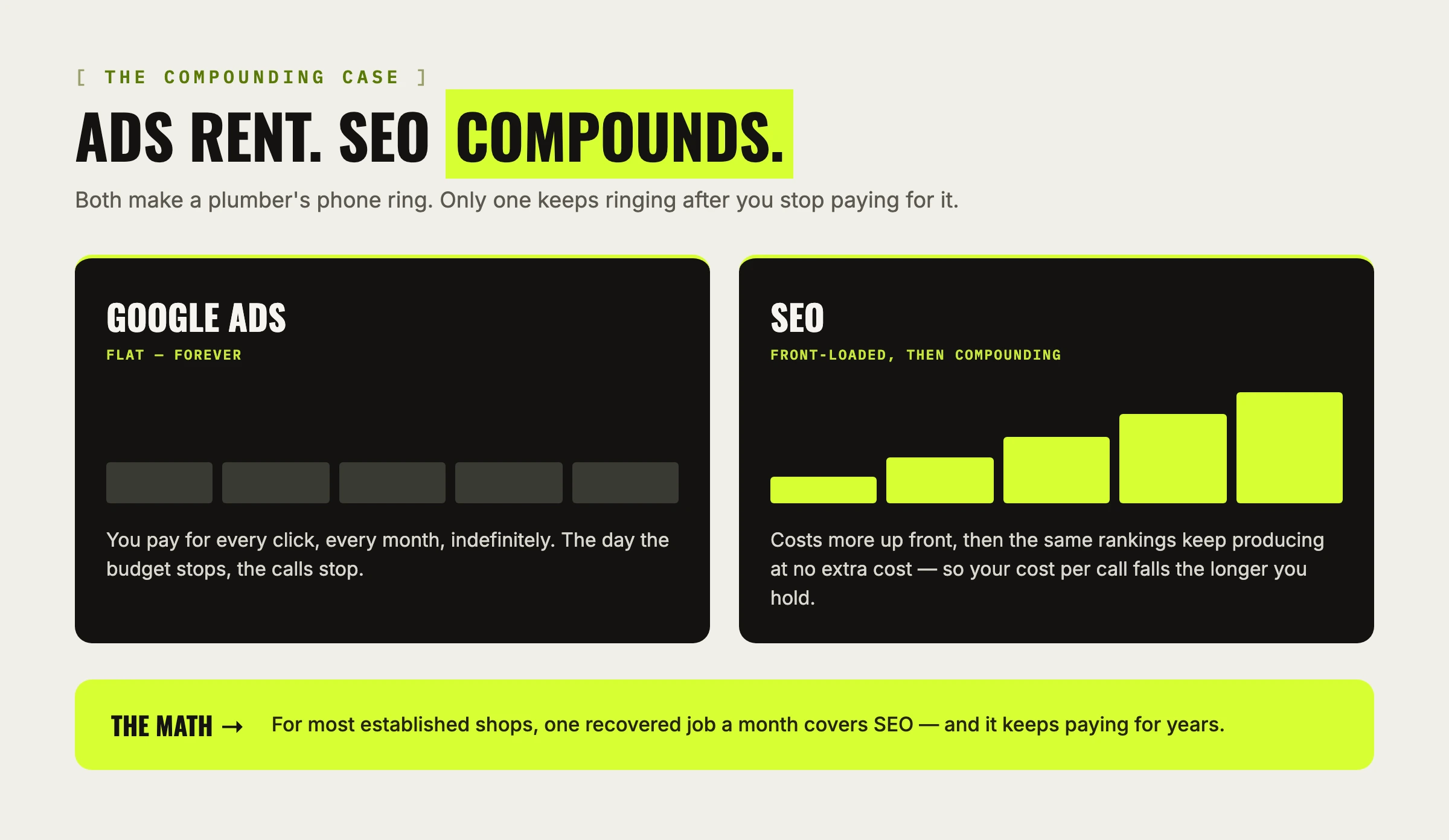
- You stop renting your calls. Google Ads is a meter. The calls stop the second the budget does. Ranking is an asset. Once you hold the Map Pack for your services, those calls keep coming whether or not you spent anything that day.
- The math gets cheaper over time. Early on, SEO can look expensive per lead. But the same work keeps producing long after at no extra cost, so your true cost per call falls the longer you hold position. Paid stays flat forever.
- Plumbing is high-intent, local, and recurring. Someone searching “water heater replacement near me” isn’t browsing. They’re buying, and they’re doing it in your ZIP code. That’s the ideal profile for local search.
- It stacks with everything else. A strong Google Business Profile, real reviews, and real jobsite proof all feed the same local ranking engine. SEO isn’t a separate lane. It’s the layer that ties your whole local presence together, and each piece makes the others rank better.
First-party proof
$4K/mo → $170K/mo
When we started with Clog Hunter, the shop was doing about $4,000 a month. Over the years we worked together, that grew to $170,000 a month. Nothing about that happened in the first quarter. It’s what the long game returns when you don’t quit early and you let the rankings do their work. See the full scoreboard.
When SEO is NOT the right first move
This is the part the sales decks skip. SEO is a long game, and there are shops it’s simply the wrong call for right now:
- You need calls this week. SEO isn’t an instant switch. If your trucks are idle and payroll is Friday, SEO won’t save you. Paid ads will, because they turn on today. Get cash flowing with paid, then build SEO underneath.
- Nobody’s searching in your market. In a tiny rural service area with almost no search volume, ranking #1 for “plumber” might mean five searches a month. Demand has to exist for SEO to capture it.
- You can’t stay consistent. SEO rewards steady, sustained work. If you’ll fund it for eight weeks and then pull the plug, you’ll pay for the hard part and quit right before the returns start. That’s the worst possible outcome.
None of that means SEO is bad. It means timing and sequence matter. For most shops the answer is both: paid for the near term, SEO for the long term. We break that tradeoff down in Google Ads vs SEO for plumbers.
Is SEO worth it for YOUR shop? A quick checklist
Score yourself. Every “yes” is a point in SEO’s favor:
- Is there real demand? Are people in your service area actually Googling your services? (Check search volume, or just ask: do you get “found you on Google” calls now?)
- Can you wait? Do you have enough work, or enough paid coverage, to survive the ramp while ranking builds? (See how long plumbing SEO takes.)
- Is your average job worth defending? The bigger your ticket (repipes, water heaters, sewer lines), the more one recovered call is worth, and the faster SEO pays back.
- Will you stay the course? Can you commit to consistent work for the long haul, not an eight-week experiment?
- Is your foundation in place? Do you have a real website you own and a claimed Google Business Profile? SEO amplifies a foundation; it can’t replace a missing one.
Four or five yeses: SEO is very likely worth it. Start building. Two or three: worth it, but fix the weak spots first (usually demand, patience, or foundation). Zero or one: start with paid and revisit SEO once cash flow and consistency are there.
The payback math you can run yourself
You don’t need a spreadsheet from an agency. Run this on the back of a napkin with your own numbers:
- A. Your average revenue per job (say, $600).
- B. Roughly what you’d pay per month for local SEO management (say, $550).
- C. Extra booked jobs per month you’d need to break even = B ÷ A.
In that example, $550 ÷ $600 works out to less than one extra job a month to break even. For most plumbers, one recovered emergency call covers the whole month, and a single large job like a repipe or heater swap covers a quarter. Now ask the real question. Once you’re holding local rankings, is it realistic that Google sends you more than one extra job a month? For an established shop in a market with demand, that’s a low bar, which is why the math tends to favor SEO once it matures. If breaking even would take five or ten extra jobs a month you can’t picture happening, that’s your signal it isn’t worth it yet.
For a full breakdown of what different budgets buy, see how much plumbing marketing costs.
Not sure if SEO is your right first move?
Tell us your market and your schedule. If paid ads are the smarter start, we’ll say so. We’d rather sequence it right than sell you the long game before you’re ready for it.
Get a straight answer on plumber marketingFor most established plumbing shops with real demand and a little patience, SEO is one of the best returns in the business: cheap, durable calls for years. Clog Hunter is proof of what it looks like when you don’t quit early. But if you need the phone ringing this week, be honest with yourself, start with paid, and let SEO build underneath. Worth it and right now are two different questions. Answer both before you spend a dollar.
Frequently asked questions
Is SEO worth it for a plumbing business?
For most established plumbing companies, yes. SEO turns Google Search and the Map Pack into a channel that produces calls without paying per click, and that traffic keeps working instead of stopping the moment you turn it off. The main catch is speed. SEO is a multi-month build, so it's worth it when you can afford to wait for the return. If your schedule is empty this week, paid ads should come first while SEO matures underneath.
How do I know if SEO is worth it for my specific shop?
Run the math and check three things. First, is there real search demand in your market? Are people Googling your services? Second, can you survive the wait, since SEO takes time to build? Third, does one recovered job cover a meaningful chunk of a month's cost? If people are searching, you can be patient, and the payback math works, SEO is worth it. If you need calls immediately or nobody's searching in your area, start with paid.
Can I do plumbing SEO myself?
Some of it, yes. Claiming and filling out your Google Business Profile, gathering real reviews, and posting real job photos are all things an owner can do and should do. The parts that take specialized time are technical site work, local content, and consistent optimization month over month, and that's where most owners stall out because they're busy running trucks. The channel rewards consistency, so the real question is whether you can sustain it, not whether you can start it.
Ready to own the territory?
Send the market, the trucks, and the goal. We’ll map the stack and show you where the leverage is.